Farmers choose a variety once a year, and the results are scattered across dozens of publications
POLMAIS is a Polish family-owned agricultural company: seeds, crop protection products and grain purchasing. Every season its team hears the same question from farmers: which maize variety will actually yield best on my field?
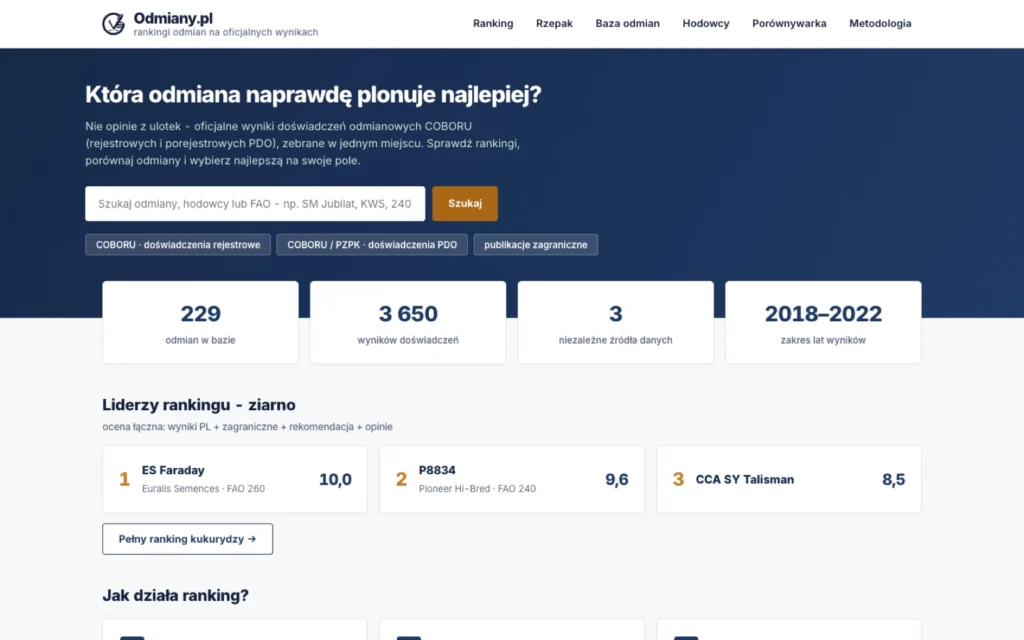
A reliable answer exists, but it is hard to reach. Official variety trial results are published in separate booklets, summaries and breeder catalogues, each with a different layout, a different set of years and a different point of reference. Comparing a handful of varieties takes an evening with a calculator, so many farmers end up choosing from a leaflet or a sales conversation. POLMAIS wanted to change that and asked us to build a portal that brings official results together and presents them in a form that can be filtered, compared and checked year by year. The result is Odmiany.pl.
What we did
We started with a conversation with the management board and the subject-matter advisor, and showed the first working version of the portal after about three weeks. The portal then matured in a test environment until it moved to its own domain.
Prototype and scoring rules
A clickable prototype of every view and written rules for presenting results, approved before any code was written.
Variety database
A custom data structure that links results for the same variety across years, publications and countries.
Data preparation
Moving official publications into the database with validation, so that no result is ever altered.
Portal for farmers
Rankings, variety profiles, a comparison tool, a breeder directory and search, designed for a phone in the field.
Identity and name
A dedicated logo and colour palette, and at launch a rebrand to Odmiany.pl across every view.
Public launch
Migration to the client's own domain and hosting, email forwarding and a live check of every page.
A variety ranking portal people can trust
A ranking only makes sense when readers know where the numbers come from. In agriculture this matters even more: a farmer who once lands on a "ranking" tailored to a single breeder will not come back. From the first meeting we agreed with the client on rules the portal never breaks: nobody edits official results, varieties from all breeders are shown under the same rules, and every result shows who obtained it and in which type of trial.
Each variety receives an overall score from 0 to 10 that combines domestic and foreign results, an expert recommendation and practitioner feedback, and the way it is calculated is described openly on the methodology page. The recommendation is always labelled as an opinion, and a variety with only a few trials is flagged as an indicative result. The portal enforces these rules itself, so they do not depend on who happens to be entering the data.
- The same rules for varieties from every breeder
- A public methodology for the overall score
- Source and trial type visible next to every result
- Clear labelling of results based on few trials
How do you compare maize varieties across years and locations?
Raw yield in tonnes per hectare says little on its own, because in a good year on good soil every variety performs better. Trial bodies therefore compare varieties to a reference, and each publication does it slightly differently. On top of that, grain and silage are two separate uses, and results from different countries are reported on scales that do not match. Putting all of this together by hand is a job for a specialist.
On Odmiany.pl every result is stored as a separate record with its year, location and trial body, and the portal brings it to a comparable form. A farmer picks the intended use, year, maturity, breeder or trial location and immediately sees an ordered list. Grain and silage never mix, and results from different countries always sit side by side rather than in a single total. A variety profile shows its results year by year and on a map of the locations where it was tested.
A comparison tool and search instead of an evening with a calculator
Before buying seed, a farmer usually has two or three varieties in mind: the one sown last year, the one a neighbour recommended and the one from the leaflet. What they need is to see them side by side, on the same data.
The comparison tool places selected varieties in one table: yield, grain moisture, maturity and overall score, with the best value in each row highlighted. Search suggests results after just a few letters and looks up variety name, breeder or maturity regardless of accents and capitalisation, so it helps even someone who remembers only part of a name. The breeder directory lets users browse every variety from a single seed company. Everything works on a phone, because that, not a desk, is where farmers most often look things up. This is how we design web applications: phone screen first, without heavy frameworks.
- Several varieties compared side by side on the same data
- Search with suggestions by name, breeder and maturity
- Filters by use, year, maturity, breeder and location
- A map of trial locations on every variety profile
An editorial panel: new results without a developer
A data portal goes out of date every season. If each new publication needs a developer, the data quickly stops being current and the portal loses its purpose. On the other hand, retyping thousands of results into forms is a reliable way to introduce errors.
The Odmiany.pl editorial team adds new results from an Excel file. The portal checks the file before saving and shows a report: what was added, what was updated and what was rejected, with the reason. The same file can be uploaded again without creating duplicates, so a correction in the spreadsheet is simply another import. Varieties, breeders and trial locations are edited in a standard panel, and roles are separated: editors handle content, while only an administrator can change the scoring rules.
Ready-made ranking plugins count stars and votes. Here every single trial result matters, along with its source and comparability across years. With thousands of records and a growing database, only a custom data structure keeps the portal fast and gives full control over how results are presented.
SEO for a data portal: every variety as its own page
Farmers search Google for specific varieties by name. A portal that shows results only in a table generated after clicking a filter is almost empty as far as a search engine is concerned.
On Odmiany.pl every variety has its own page with a description, results and structured data that Google understands, and the portal also describes its data in a way dataset search engines can read. Filtered views do not multiply duplicates in the index, and an FAQ page answers what farmers ask before buying seed. All of it without third-party SEO plugins. Read more about our SEO and digital marketing work.
Security and an independent identity
A portal with public data attracts not only farmers but also bots probing for weak spots in WordPress. We secured it without adding third-party plugins: the admin panel is not available at the standard address, and technical data is accessible only to logged-in users.
Odmiany.pl has its own logo and colours, deliberately different from the publisher's online store. The portal is meant to be seen as a tool for the whole market rather than one company's website, and that principle runs from the visual identity all the way to the ranking rules.
Lessons for companies planning a similar project
In data-driven projects, the time best spent is on the rules, before the first screen exists. What may be calculated, what must never be combined, how to label an opinion and how to treat an uncertain result. Rules written down at the start let us build quickly, because every design decision had a reference point, and the client knew from the first prototype what they would get.
The second lesson is about freshness. A data portal is only as good as its latest import, so convenient and safe uploading of new results matters as much as how the ranking looks. If you are planning a similar tool for your industry, see how we build software for agriculture and other custom solutions.