Manual status changes
Someone moves orders, prints labels and sends confirmations every day, although automatic actions could do it.
We configure BaseLinker (Base.com) and Apilo so that orders from every channel move from payment to shipping label without clicking. An integration watchdog monitors the account and alerts you before an order gets stuck.
The integrator is connected, but the team keeps clicking. It is the most common state of accounts we take over.
Someone moves orders, prints labels and sends confirmations every day, although automatic actions could do it.
A paid order waits a day without a label because the courier integration returned an error nobody saw.
The listing queue grows, and some listings never reached the marketplace because of a missing parameter or category.
Allegro, the store and Ovoko run in different modes, with different message templates and different packing.
Ready-made integrations show errors in the panel, but nobody looks at the panel every hour. The watchdog looks for you and writes only when action is needed.
First we write down how an order moves through your company today. Then every step that repeats without exceptions is taken over by automation.
Status change rules after payment, printing and dispatch, with conditions for channel, country, courier and order value.
Courier and parcel size selected by rules, labels and tracking numbers returned to the order and to the marketplace.
Allegro, Ovoko, eMAG: category and parameter mapping, per-channel price lists, statuses sent back.
Invoices and receipts by order source, transfer to accounting software, submission to national e-invoicing systems such as KSeF in Poland.
Status changes, for example for returns, for hundreds of orders at once from a spreadsheet, with a report of what succeeded and what did not.
A product photo and a few details, and the system prepares a product card with a description for approval before listing.
Each of these makes sense in a different company. We calculate what pays off before switching anything.
| BaseLinker (Base.com) | Apilo | Custom hub in the store | |
|---|---|---|---|
| Best when | You sell in many channels and need advanced rules | You want a simpler panel and work with typical sales and warehouse software | The middleware limits you or costs more than it delivers |
| Automation | Automatic actions with conditions and extra fields | Rules and automations for orders and documents | Any rules in code, built around your process |
| Fixed cost | Provider subscription | Provider subscription | Hosting and care, no middleware subscription |
| What we do | Implementation, actions, watchdog, API add-ons | Implementation, rules, watchdog, API add-ons | Design and build, as for ALU-GUM |
Custom hubs, ERP connections and links that ready-made integrations do not cover are described on the system integrations page.
Automatic actions explained: Base.com (BaseLinker) knowledge base.
An automation that fails on an exception costs more than manual work. That is why we test on order history.
Two projects, two different decisions.
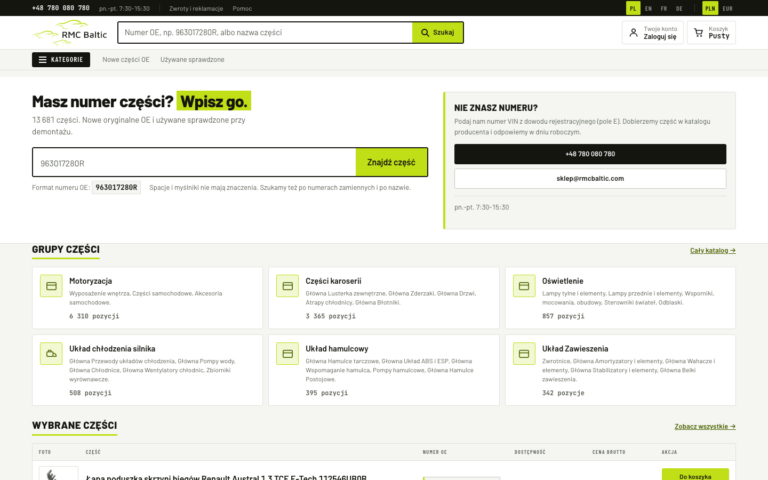
A new store for a running business: 216 BaseLinker rules work without a single change, confirmed on 200 orders from 75 days.
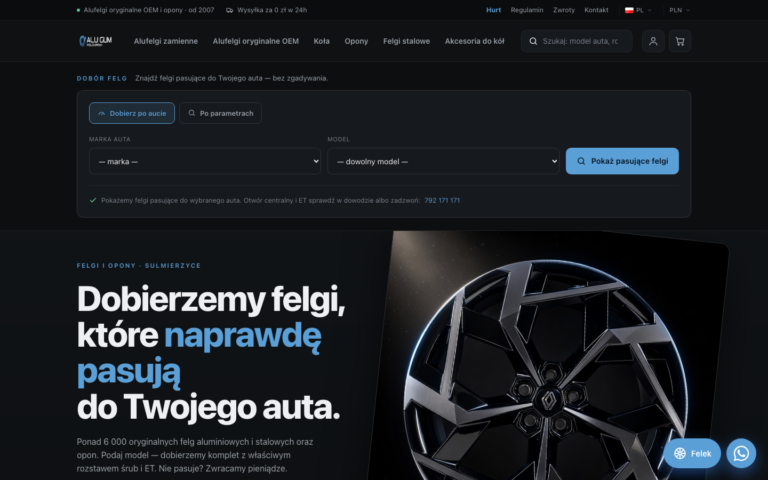
See the case studyA custom hub instead of BaseLinker: Allegro through the API (prices, stock, orders, listings from the product card), Polkurier and Przelewy24.
See the case studyNet prices. We give the exact amount after reviewing the account, before you decide.
Integration watchdog, automatic actions for your process, bulk status changes from a file and adding a product from a photo with a description.
Ongoing account supervision with alerts and our response to problems, a monthly report and thresholds adjusted to the season.
Replacing the middleware or connecting accounting and warehouse software.
Changes outside the package are billed hourly at our standard rate. Scripts and documentation are yours.
The automation package starts at €650 net: an integration watchdog, automatic actions matched to your process, bulk status changes from a file and adding a product from a photo with a ready description. Ongoing watchdog supervision with response to alerts starts at €65 net per month. We give the exact amount after reviewing the account, before you decide.
It is our script that checks the account through the API every few minutes: whether orders from marketplaces keep coming in, whether anything is stuck in a status, whether the listing queue is growing, whether there are listings with errors and whether shipping labels are generated. When something deviates from normal, you get an alert describing the problem before a customer notices or a marketplace lowers the account rating.
Both connect your store, marketplaces, couriers and sales documents. BaseLinker (sold internationally as Base.com) has the most integrations and advanced automatic actions; Apilo is simpler and widely used by Polish wholesalers working with local sales and warehouse software. We advise based on your sales channels, accounting software and packing process, not on habit.
When the subscription and the limits of the middleware grow faster than sales, or when you need rules the tool cannot handle. For ALU-GUM we built a custom hub inside the store: Allegro through the API, courier and payments. If the middleware works well, we keep it and automate what is already there.
It does not have to. When RMC Baltic replaced its store, 216 BaseLinker rules kept working without a single change, which we verified on 200 orders from 75 days before the switch. We test every change on order history, not on live customers.
Yes. We configure marketplace integrations in BaseLinker and Apilo, category and parameter mapping, per-channel price lists and the statuses sent back to the marketplace. When a ready-made integration does not pass something on, we fill the gap through the API.
You do. The BaseLinker or Apilo account is yours, and we hand over the watchdog and automation scripts with documentation, so you can develop them with any team.
See also: business process automation and AI, AI chatbot for websites and stores, system integrations.
List your channels, couriers and invoicing software. We will tell you what can be automated and what it costs. We reply within 24 hours.