
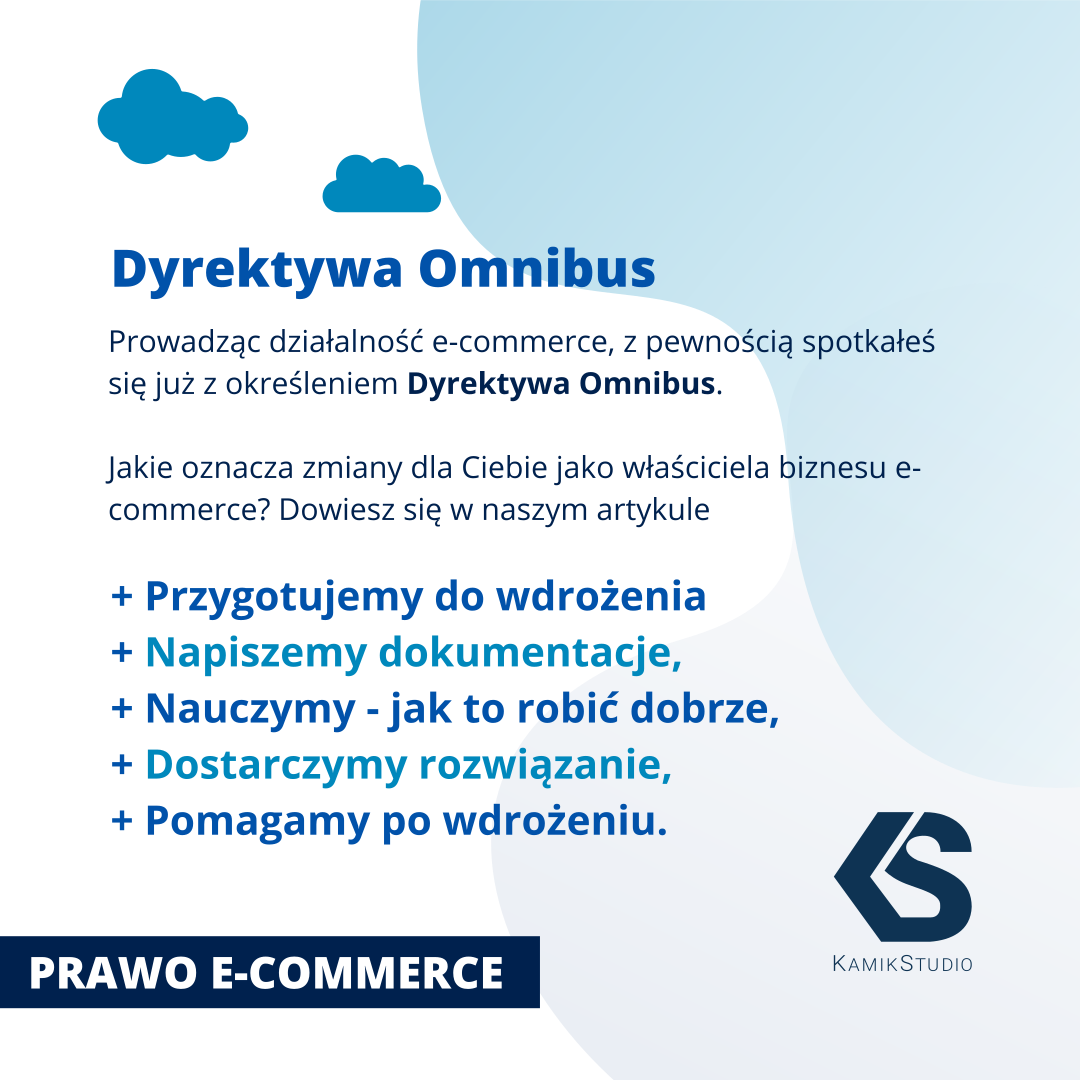
Running an e-commerce business, you have surely come across the term Omnibus Directive. In the article below you will learn what this Directive is, what it means for the customer, and above all, what changes it brings for you as an e-commerce business owner.
The Omnibus Directive
It is Directive 2019/2161 of the European Parliament and of the Council of November 27, 2019. For those interested, the full text is available here (EUR-Lex - 32019L2161 - EN - EUR-Lex (europa.eu)). This directive amends the existing consumer protection directives:
- The Price Indication Directive (1998/6/EU) (EUR-Lex - 31998L0006 - EN - EUR-Lex (europa.eu) )
- The Unfair Contract Terms Directive (1993/13/EEC) (EUR-Lex - 31993L0013 - EN - EUR-Lex (europa.eu) )
- The Consumer Rights Directive (2011/83/EU) (EUR-Lex - 32011L0083 - EN - EUR-Lex (europa.eu) )
- The Unfair Commercial Practices Directive (2005/29/EC) (EUR-Lex - 32005L0029 - EN - EUR-Lex (europa.eu) )
EU member states had to transpose this directive into their national law by November 28, 2021. According to the draft, it was to come into force on May 28, 2022. However, it had not completed the full legislative process, which meant it was not yet binding for e-store sellers. Regardless of when it takes effect, it is worth getting familiar with its core principles and preparing for the changes. After all, whoever adapts to the new rules first will certainly gain.
Update (August 2026): the legal status above reflects the time of publication. The Omnibus Directive has since been implemented into Polish law and, as of January 1, 2023, fully applies to all online sellers - the rules described below (including displaying the lowest price from the 30 days before a discount) are no longer a plan but an obligation enforced by the consumer protection authority (UOKiK).
The main goal of the Omnibus Directive is to protect consumers when contracts are concluded in specific circumstances and in the customer's home. Above all, it is about online buying and selling, which is now meant to be more transparent.
The most important areas where changes are introduced are:
- a clear marketing policy
- transparent information about the seller
- the "authenticity" of reviews
- a fair pricing policy
The Omnibus Directive and marketing policy
The first change applies not only to search engines but also to all kinds of marketplaces, such as Allegro. All listings whose display positions result from paid advertising must have this fact clearly marked. It has to be done in a way that leaves the user with no doubt. As we know, the higher we rank in search results, the greater the chance that a user becomes our customer. The amended rules oblige the platform owner to disclose which of the top search results got there organically and which through paid advertising.
Marketplaces must also make available to the user the criteria determining the order in which search results are displayed. This does not mean revealing the full algorithm. Only the criteria that decided the given display order.
The Omnibus Directive and transparent information about the seller
This point essentially applies only to marketplaces and platforms such as Amazon or the aforementioned Allegro. The customer must be clearly informed who the seller of a given product or service is. To put it more precisely, the seller must clearly and plainly tell customers whether they are a private individual or a registered business. This matters because a customer buying from a private individual has considerably narrower consumer rights.
The second important aspect of this point is informing the customer precisely who is responsible for the product/service in the event of a return or complaint. There has often been confusion in this area. Since the Directive came in, the customer must know clearly whether, in the event of a complaint, they should turn to the seller, the platform, or perhaps another entity.
The Omnibus Directive and the "authenticity" of reviews
When deciding on a specific service provider or purchasing a product, customers very often rely on reviews found online. After all, who can advise better than someone who actually uses the product. Under the new rules, the seller is obliged to verify the authenticity of newly appearing reviews.
The Directive is meant to ensure customers get the most honest and truthful reviews possible. This means that such a review cannot be published by a random person with internet access, or by just "anyone". It has to be a person who actually bought the product and used it. Reviews will become a genuinely reliable source of information for users potentially interested in buying.
The Omnibus Directive and a fair pricing policy
This is essentially where some of the most significant changes from the customers' perspective sit. No more artificial price cuts before Christmas or Black Friday.
According to the new guidelines in the Directive, when introducing a price reduction, a store is obliged to inform customers of the previous price - specifically the lowest price applicable during a period of no less than the last 30 days before the reduction.
The second important piece of information that must be available to the customer is the use of automated tools to decide the price of a given product. If a store uses one, it must include such a note.
Is your store ready for the Omnibus Directive?
The e-commerce industry implementing the new rules arising from the Directive will certainly give customers more reliable knowledge and safety. But it will also let businesses earn more trust from users.
Adapting a business to the new rules requires knowledge, experience, and the right logistical and legal backing. As KamikStudio, we can help you get through this process smoothly.
If you already run an online store based on PrestaShop, you can use a solution built for the directive. Buying with the discount code KAMIK_HMXHWT6J gets you the module 10% cheaper. The solution is available here - click.
If you need support, implementation or help - write to us!
If you are still at the stage of planning your online store, get in touch. We will comprehensively handle not only building the store of your dreams, but also provide you with a domain and lh.pl hosting
See more
- WordPress Malware Keeps Coming Back? A Case Study
- Custom Software or Off-the-Shelf? Running the Numbers for Manufacturing
- How Much Does Custom Software Cost? Real Price Ranges for 2026
- The Standard: What Exactly You Get in Every KamikStudio Project
- How Much Does a Website Cost in 2026 and Where the Price Comes From