

Over the last two years, interest in online shopping has been growing steadily (in 2022, 77% of internet users already declared that they shop in online stores) - you can read more about it in our articles on the e-commerce report for 2022. The pandemic certainly played a considerable part in this popularity. But what can we expect in the coming year? What are the e-commerce predictions for 2023 and, accordingly, what should you prepare for to keep up with the trends? Read on, and if you need help with any aspect - write to us!
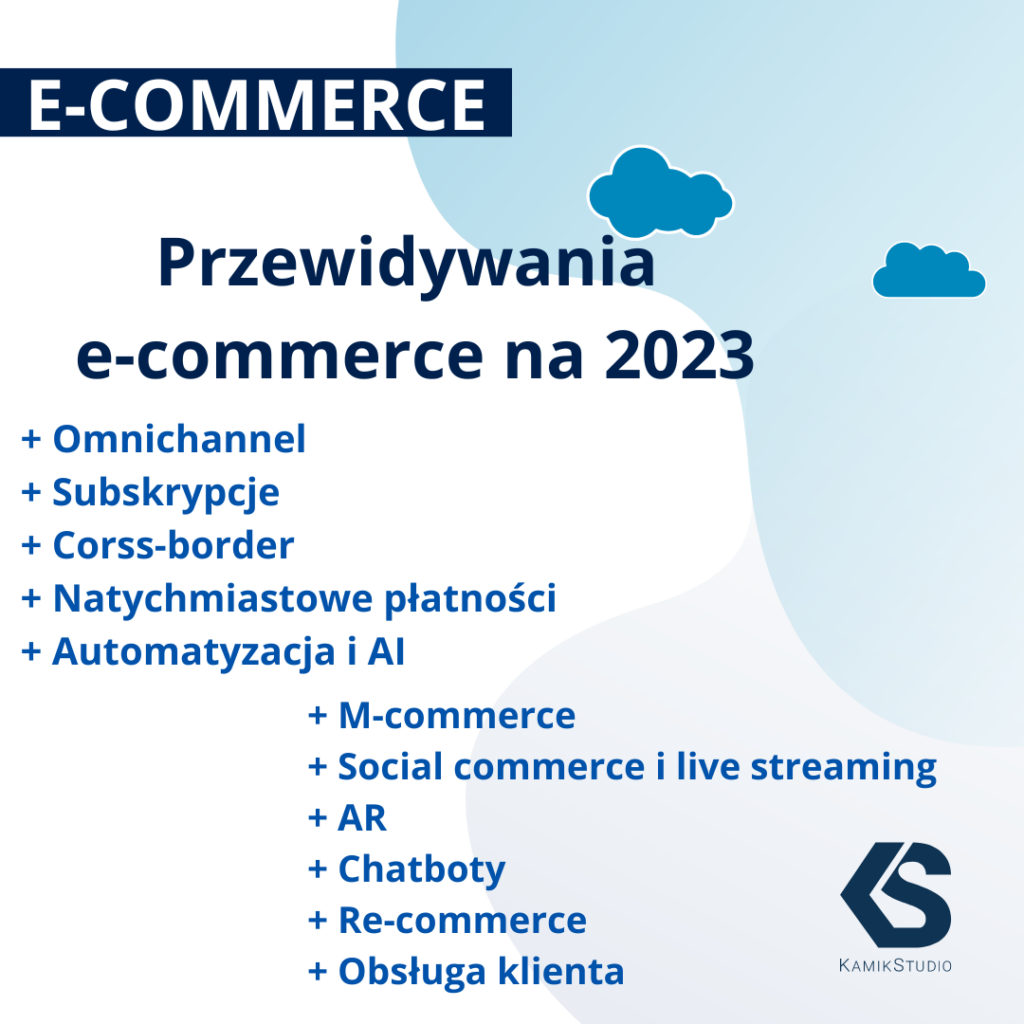
Omnichannel
This is a model where customers can freely choose between sales channels. By offering this possibility, a brand gains consumer trust. Nowadays a single sales channel is not enough; customers really like seeing things in person and buying online, but just as often they compare products between online stores and end up buying in a physical store. That is why connecting all points of sale well is extremely important.
Subscriptions
The very idea of a subscription is well known to us, if only from services like Netflix or Disney+. The customer places an order, pays for it, and it is renewed for the period the subscriber agreed on with the seller. This type of solution works particularly well in industries selling products needed on a recurring basis, e.g. cosmetics, dietary supplements or even household chemicals. The hardest thing in e-commerce is acquiring a customer, and subscriptions are an excellent way to retain one.
Cross-border
E-commerce predictions for 2023 also include international sales. For many companies local markets are not enough, so they decide to take their offer beyond their country's borders. More and more store and sales platforms are meeting this need, making it easier for entrepreneurs to expand abroad. Cross-border selling is also made easier by, among other things, smart translations and integrations with couriers and marketplaces.
Even faster payments
The ability to pay instantly is very important for the e-commerce industry. Not having to switch over to a bank or other platforms increases the chances of the user completing the transaction. Today's buyers like fast, hassle-free shopping and often buy on their phones on the go. The shorter the purchase path, the more conversions.
Process automation and AI
The better all processes are automated, the smoother and more efficient the operation. This can apply, for example, to the speed of handling and shipping new orders placed in the store. AI, in turn, allows for better personalization of the offer for users and customers. It tailors it to, among other things, search history or previous purchases made on the site. This creates a feeling of uniqueness and ties the customer more closely to a given store.
M-commerce
No one needs convincing that internet users browse websites on their phones. This route is also increasingly used for shopping. In 2022, mobile devices were even used for shopping more often than desktop computers. This creates the need to continuously improve the mobile versions of websites. When using a phone, the user often does so spontaneously, quickly, on the go between other tasks. A store should be built simply, so that using it is intuitive and doesn't require, say, both hands. The fewer the barriers, the greater the chance of a successful transaction.
Social commerce and live streaming
Shopping on social media is a sign of our times. More and more often, products are bought directly through Instagram or Facebook, and even TikTok. Social media makes it possible to create a unique bond between the seller and the customer, which has a considerable impact on purchase decisions.
Augmented reality
Augmented reality offers possibilities that were previously out of reach for e-commerce stores. The customer can almost "try out" a given product. Thanks to the right filters a store can provide, smartphones let you check, for example, how a piece of furniture from the assortment would look in your apartment, or even "try on" clothing offered by the online store.
The role of chatbots
It is fair to say that most stores have chatbots on their websites. It is a constantly growing trend that lets the customer feel almost like they are talking to a salesperson. Chatbots can answer the most frequently asked questions and doubts, and also suggest products matching those already in the cart, which can help the customer make the final purchase decision.
Re-commerce
Outlets and second-hand marketplaces, as well as second-hand sales, have recently been a rapidly growing part of e-commerce. This is happening for two reasons. First, a significant part of society has increasingly tighter budgets for all kinds of shopping and is looking for cheaper options. The second is growing environmental awareness.
Customer service
Regardless of all the conveniences, customer service should be excellent. The user should be able to get answers to their questions on every channel where the company is present. By phone, by email, and through existing social media profiles. Messages left unanswered for a long time can result in losing the customer and their trust.
If the e-commerce predictions for 2023 are giving you trouble and you need help keeping up with what's new, write to us. We will help you align your business with the current trends.